

When jobs are cut, the focus is on the leaving employees, of course. After all, they are losing their jobs, and severance pay, outplacement, and transfer schemes are correspondingly costly. A great deal of energy is needed for negotiations, and so attention, particularly in communication, is often focused solely on implementing staff reductions. Yet, there is one usually overlooked target group which is essential for the success of the restructuring:
Who actually implements the restructuring? It is the employees who remain, the so-called “survivors”. Even though they are the key to success, they are frequently ignored.
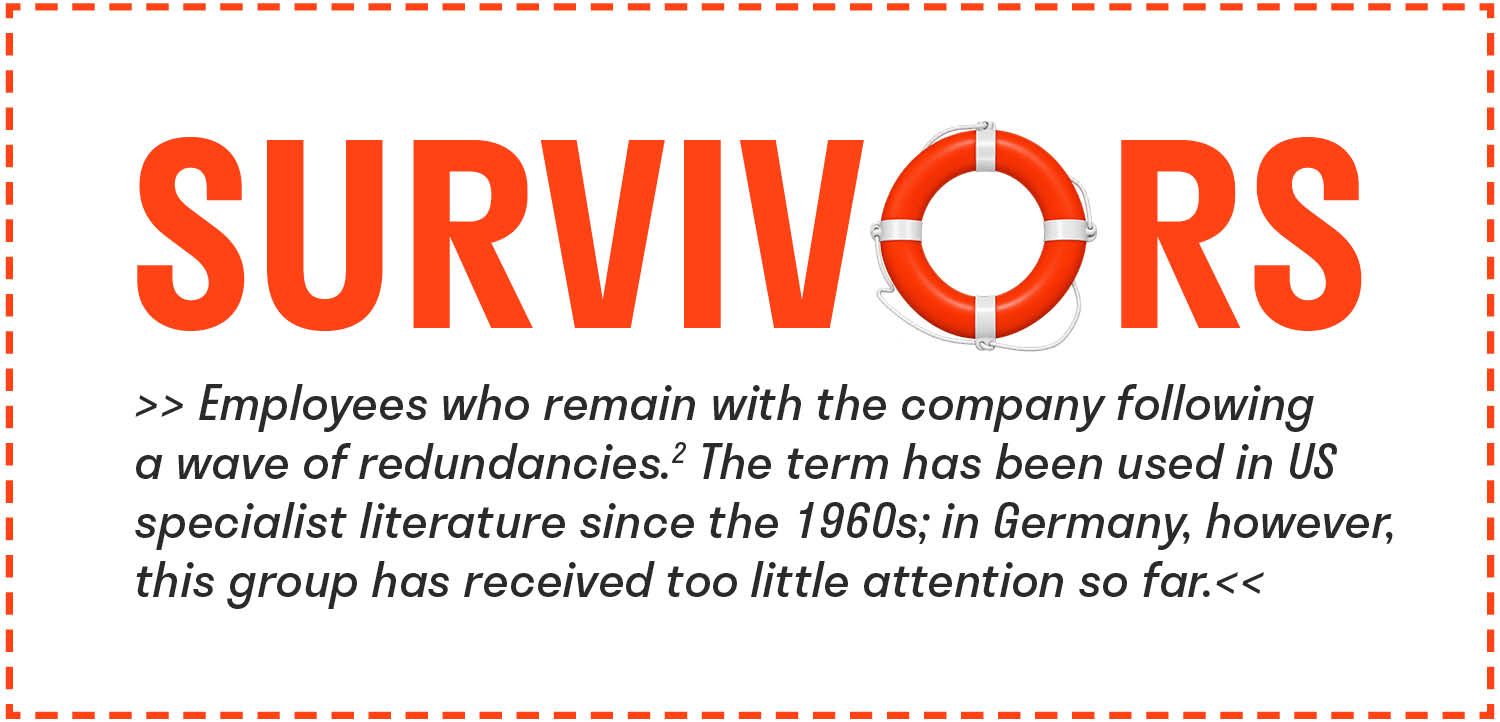
American specialist literature coined the term “survivors”1 for this group as early as the 1960s. In Germany, academic research has paid comparatively little attention to this target group to this day – which may be a reason why it is so often underestimated.
How can we best do
justice to the survivors?

INVOLVING THEM FROM THE START,
NOT EXCLUDING ANYONE.
“They should count themselves lucky,” one might think, because after all, survivors keep their jobs. But that’s not the full story. A qualitative longitudinal study (DER SPIEGEL WORK, issue 34, 17 August 2026) shows that identification with the employer declines, most of all among those who stay. Uncertainty, grief, anger, and mistrust are understandable, but pose a risk. As a result, communication must address the entire workforce from the start – those who leave and those who stay.
1 https://www.hrtoday.ch/de/article/survivors-oder-die-letzten-beissen-die-hunde / November 2026
2 https://edoc.ub.uni-muenchen.de/15407/1/Dietrich_Kristina.pdf / November 2026
EXPLAINING THE NEW ORGANISATION –
THROUGH MANAGERS TOO.
A new organisational chart does not mean a functioning organisation. What is said is not necessarily heard, and what is heard is not necessarily understood. In particular, middle management must explain the new structure and lead by example. A communication kit containing Q&As, key questions and clear graphics will be of much help. It is also important to clarify whether the “survivors” have the necessary skills for their new responsibilities.
CREATING A NEW NORMAL
AFTER THE DOWNSIZING.
Restructuring does not merely reduce headcount. In fact, it transforms the entire social system: expertise has been lost, resources and budgets are tighter, and esteemed colleagues are gone. There is no going back to the old normal. The survivors must now be focused on in communications. Their sense of identification must be maintained or reestablished, especially when more effort is expected from them.
PAINTING AN ATTRACTIVE
PICTURE OF THE FUTURE.
Salaries, benefits, and good working conditions are important, but already known. Instead, a purpose that makes people want to come to work in the morning creates the strongest commitment. Such a vision for the future is not based on turnover or market share figures, but answers substantial questions: What does the company want to do for its customers? What does the new value proposition consist of? How does it differ from the competition? A prerequisite is a completed strategy process, with the vision developed by an interdisciplinary team and embedded through impactful communication which is not necessarily expensive.
Conclusion.
Strategy, measures, and organisation can be decided upon. But whether the company’s future is a success is determined by the survivors. The more they are placed at the centre of communication at an early stage and in a convincing manner, the higher the likelihood of the restructuring’s success. Motivating them and aligning them with the future is essentially a communication task.
Anyone who forgets the survivors during a restructuring risks losing precisely what was meant to be saved: the future of the company.
See you next time for an espresso!
Best regards,