

In January 2024 our client Ulrich Ladurner, a visionary South Tyrolean entrepreneur, sent me an e-mail with the subject line “Please get Florence Gaub’s book ‘Future’ urgently”. At the time we were working on the basics for a new product brand for his company, Dr. Schär, and it was a project with very far-reaching prospects – into the future. This made it all the more rewarding to deepen our understanding of the task by talking about Florence Gaub’s theses. Bought the book. Read it. Enthralled.

Today, thoughts about the future don’t always trigger a sense of euphoria. The uncertainty that our future is inherently connected with is the lesser problem. After all, in view of all the developments we feel we’re exposed to, for example the environment, world order, the economy, populism and artificial intelligence, we can sometimes lose our anticipation of what’s on the horizon.
The future – a user’s guide.
It’s quite different for Florence Gaub, political scientist, military strategist and futurologist. Florence Gaub is fascinated by the future – in her view, the fact that we can imagine the future at all attests that we have a higher power that’s only reserved for us humans. No other organism on this planet has ever been proven to have this ability. We, on the other hand, can imagine a time that does not yet exist, and so vividly that our brain processes this concept almost as if it’s a memory. This gives us courage, and of course arouses curiosity as to exactly what her user’s guide for the future looks like.
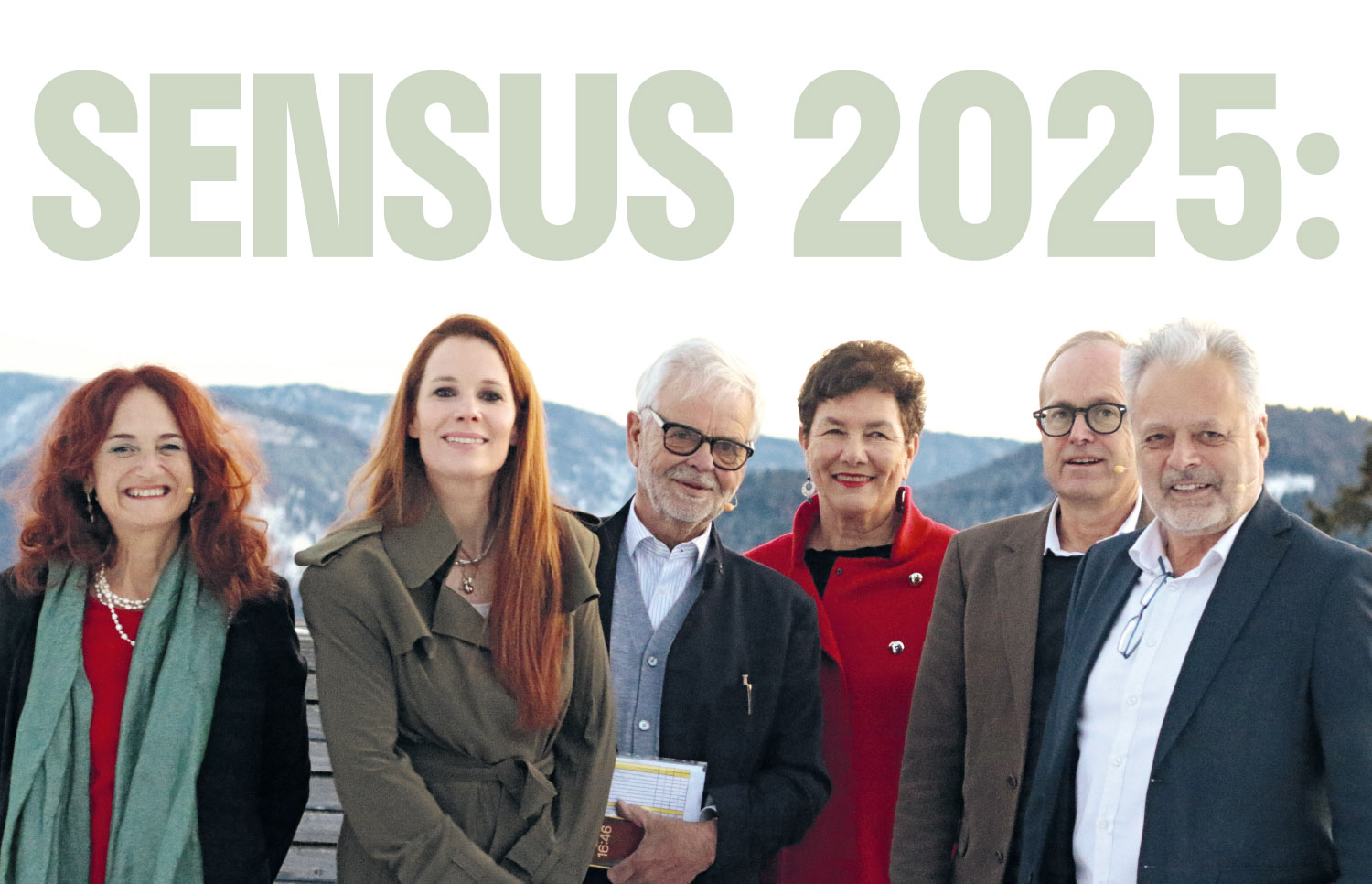
Sensus 2025: (left to right:) Brigitte Foppa (Member of Parliament for the South Tyrolean Green Party), Dr. Florence Gaub, Ulrich Ladurner, Claudia Plaikner (Chairwoman of the Local Heritage Society), Professor Dr. Martin Zagler (Vienna University of Economics and Business and University of Eastern Piedmont), Professor Dr. Harald Pechlaner (Catholic University of Eichstätt-Ingolstadt). Photo: courtesy of Vigilius Sensus.
“Future. Knowing what is not (yet).”
Sensus takes place once a year, usually at the end of November, and it’s a series of events that was brought to life by Ulrich Ladurner in 2012. Its aim is to create a public forum where renowned minds discuss various aspects of social development. One owes him an expression of gratitude for this format, because until now it has been exceedingly inspiring and stimulating on every one of my visits so far. He deserves special thanks for making it possible to invite Florence Gaub to the most recent Sensus event in November 2025. Her presentation was a hopeful and fascinating look into the future, and, primarily, how to deal with it. The lecture gave the audience something that is too often lost when thinking about the future, especially in current times: confidence.


Sensus has been held on Monte San Vigilio at the Vigilius Mountain Resort since 2012. The 5-star hotel located near Meran in South Tyrol is at an altitude of 1,500 metres and can only be reached by cable car, and most of the around 40 rooms offer sweeping views of the land – far beyond the Dolomites on clear days. The sustainably designed house harmoniously blends into a place of peace, tranquillity and nature. The Vigilius Mountain Resort was constructed in the early 2000s on the initiative of Ulrich Ladurner together with the architect Matteo Thun – a style icon was born that continues to be a role model for a new form of ecological luxury. Today the hotel is managed by Ingrid Ladurner.

Sensus 2025: If we follow the thoughts of Florence Gaub in her presentation there is not just one future. She distinguishes between four different ‘futures’: the daily future (how do we spend the day?), the personal future (how do we plan the next year?), the times in which we live (i.e. the next 10 to 15 years), and ultimately our broader, collective future, meaning the future of the planet.
It is noteworthy that, according to Gaub, we spend on average around 80% of our time on the daily future, only 14% on the coming year and only 6% on the next 10 to 15 years.
The broader, collective future, in contrast, does not seem to be a topic that we usually address. Florence Gaub has several answers as to why this is. On the one hand, the utility value of the small, daily future feels more pertinent to us because life takes place in the here and now. And on the other, Western societies in particular are orientated more towards the past than the future – this can be seen for example in the fact that schools teach subjects such as history and Latin, but hardly any subjects that cast their glance to the future.

“It’s not what’s ahead –
it’s what’s in your head.”
In her lecture, Florence Gaub describes the future not as a fixed event that is ahead of us but as a space full of possibilities. Particularly succinct is the phrase “It’s not what’s ahead – it’s what’s in your head”, and which of these possibilities becomes reality depends to a high extent on how optimistic or pessimistic we are, she claims. Can we influence the future or not? It’s all about estimating our influence on the future. If we assume that we have an influence on the future, we can adopt a formative role. The future doesn’t happen, the future is made.

Florence Gaub recommends both defensive and offensive methods for a constructive approach to the future. Defensively, the question is what do we want to protect and what do we want to preserve? Which precautions can we take to ensure we can achieve that? – Applying an offensive approach means analysing our wishes for the future. Which future feels right? Which images give us confidence and hope? The future is a feeling, says Gaub. People become active if their vision of the future is appealing. Pure fear stories – such as climate change – have low motivational potential and can quickly lead to denegation. Florence Gaub argues that our society must once again learn to create a positive image of the future, and she believes that participation, meaning genuine social involvement, is of central importance. Every society, every company and every person needs a positive image of the future.

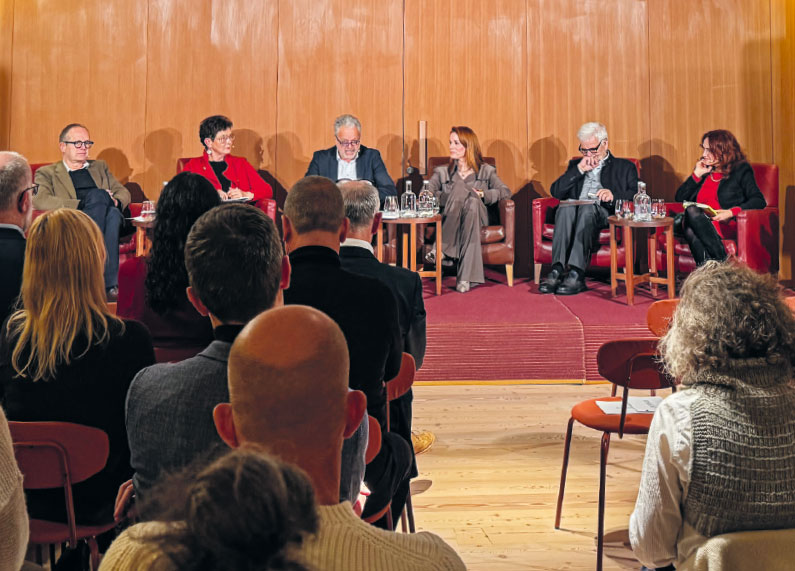
The discussion kicks in.
After Florence Gaub’s lecture, Professor Harald Pechlaner, Head of the Centre for Advanced Studies of Eurac Research in Bolzano and Professor at the Catholic University of Eichstätt-Ingolstadt, moderated an interdisciplinary discussion with Ulrich Ladurner, Florence Gaub, Brigitte Foppa (Member of Parliament for the South Tyrolean Green Party), Professor Martin Zagler (Vienna University of Economics and Business and University of Eastern Piedmont) and Claudia Plaikner (Chairwoman of the Local Heritage Society) for the approximately 90 guests at the event.
Photo: courtesy of Vigilius Sensus.
For more information on this event see www.eurac.edu/de/events/vigilius-sensus-2025
or www.vigilius-sensus.org.

I take away several thoughts and considerations from this event, both of an inspiring and of a confirmatory nature. One thing is clear: communication has a fundamental role in shaping the future. The reason is that the positive impressions and images of the future that Gaub calls for are created mainly by the fact that they are narrated. In consequence, I keenly anticipate continuing to develop such positive images of the future for our existing and future clients – whether it’s a new brand design that reflects their identity, or supporting broad transformation processes, or in acute situations for which forward-looking communication is an important factor for success. With this in mind, here’s to a happy new year!

With this in mind, here’s to a happy new year!
Florence Gaub
Dr. Florence Gaub is a political scientist, futurologist and research director at the NATO Defense College in Rome. She advises governments and international organisations with trend analyses and future scenarios. Florence Gaub is a German-French citizen, served as a reserve officer in the French army and studied at Sciences Po in Paris, the Sorbonne and the University of Munich, followed by a doctorate at the Humboldt University in Berlin. She has written several books, including “The Future. A User’s Guide” in 2023 and “Szenario: Die Zukunft steht auf dem Spiel” (Scenario: The Future Is at Stake) in 2025 (both published by dtv, Munich).
Ulrich Ladurner
Ulrich Ladurner founded the company Dr. Schär in 1980, which initially specialised in the production and distribution of gluten-free foods for people with coeliac disease. Based on his mission of “We improve the lives of people with special nutritional needs”, the company now employs more than 1,700 people at 18 international locations in 12 countries. Today the focus is still on gluten-free foods, but Dr. Schär also offers numerous other products for special dietary needs.
Jens Petershagen
Jens Petershagen founded Petershagen Communications GmbH in 2008, his strategic management consultancy for identity-based communication. After studying economics in Stuttgart-Hohenheim and German, Romance languages and business studies at the University of Cologne, he worked for Daimler, Deutsche Telekom and RWE as well as for the agencies Springer & Jacoby in Hamburg and BBDO in Düsseldorf. Petershagen Communications now mainly advises mid-sized and family-owned businesses in the DACH region. Jens Petershagen and his team have been advising Dr. Schär since 2014.